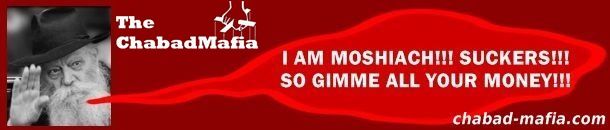
Menachem Mendel Schneerson
By all accounts, during his youth and until he became the Rebbe in New York, Menachem Mendel Schneerson was an assimilated Jew, who had abandoned the Chabad, the Hasidic, and the Jewish way of life. While in Europe, he obtained a technical degree in engineering from a second class college in Paris, at the age of 36. He never studied in any yeshiva, he never worked a day in his life, he never even attended synagogue while living in France, he was an alcoholic who spent lots of time in bars. His wife, Chaya Mushka, happened to be the daughter of the 6th Chabad Lubavitcher Rebbe, and since there was no one else to take the position, he became the 7th Rebbe after the 6th Rebbe died. This is why some people refer to him as "the accidental Rebbe".
The days in Europe were his real life. When the war started and the Nazis invaded Paris, his father in law succeeded in bringing Menachem and Chaya to New York, where they no longer had a life. Menachem Mendel Schneerson arrived in New York at the age of 41, and he never had any children. His wife Chaya, did not like the idea that his husband became the 7th Rebbe, and she refused to be called Rebetzin, which is the proper way to call a Rabbi's wife. Menachem Mendel Schneerson was never trained to be a Rabbi, and he was not a Torah Scholar. In fact, he was very ignorant of basic Jewish Law and tradition, just like his followers. His followers created a lot of false propaganda around him to make him look good, such as saying that the Rebbe had received a PhD from the Sorbone, but it's all just a bunch of lies.
"The Rebbe: The Life and Afterlife of Menachem Mendel Schneerson" is a biography of the Rebbe that was published on May 2010, and was written by Samuel Heilman, of City University of New York, and Menachem Friedman, of Bar Ilan University in Israel. This book angered many Chabad fanatics, as it greatly exposes the fraud and lies that Chabad has invented around their false Messiah. Basically, Menachem Mendel Schneerson was just an average person, and nothing more than that. But Chabad is all about money and power, and their "Rebbe" is just part of their scam.
The Double Afterlife of Mendel Schneerson
by Ben Atlas (May 29, 2010) Source: BenAtlas.com
I just read The Rebbe: The Life and Afterlife of Menachem Mendel Schneerson by Samuel Heilman and Menachem Friedman. There seem to be a lot of "life" in these titles, the original biography by Shimmy Deutsch described the Rebbe as "larger than life". Both titles tap into the unrecognized idea that the Rebbe indeed lived a double afterlife. His first afterlife was in Brooklyn and his second afterlife is the lasting legend and the legacy. Mendel Schneerson had his real life of a human being prior to coming to America and this very humanity that irks people who internalized the Rebbe in his "official capacity". From that perspective any actual detail about the Rebbe's life as a human being is historically inaccurate. It's a sacrilege like a Mohammad cartoon. If mythologically speaking he attended the Sorbonne in his role as the Rebbe, he certainly did so as Mendel Schneerson in Paris.
Moreover when the idolized image is internalized as a part of an identity, any deviation from the iconic description is a personal attack (a note to the book's detractors). The character known as the Rebbe is projected in both directions, into the future where he continues to live eternally and into the imaginary past where he is getting ready for his messianic role. This is what Marshall McLuhan meant when he said that "we march backwards into the future". There is the afterlife in Brooklyn and the literal afterlife of the Messianic redeemer "may he live forever and ever" after Brooklyn. To be sure the Ramash proved a willing participant in the mythology mongering. So naturally my interest was always in the years when the Rebbe was still a Russian refugee Mendel Schneerson, a human being so to speak. There are new details and the chronology in the book that complete this human picture at the backdrop of Dnepropetrovsk, Berlin and Paris, the "human period".
Ohh so dear to the Rebbe himself contradictions, as I mentioned in my offbeat biography (see below). For the Rebbe his marriage to the royal family was his life and death. It's astounding that the entire time while a nomad in the European capitals Mendel Schneerson never held a job or produced any income (40 years of his "real life" plus 10 years in Brooklyn!). This in itself perhaps is not that unusual for the aristocratic culture but what is surprising is that Mendel Schneerson managed to pull this off while going explicitly against the wishes of his benefactor, the father-in-law. Still if not for the connection to this family, to the Rayatz, most likely that Mendel Schneerson would perish in Russia or Europe. But this very connection eventually stripped him of his own humanity, made him enter the "afterlife" while still in this world. This also true even for Mussiya Schneerson herself as she spent her years in Brooklyn entombed, buried alive in the self-imposed house confinement on the President St., surrounded by the very peasants she was so desperate to escape, lamenting as the book notes "her best years in Paris". And the literal erasure when the famous Schneerson inbreeding infertility paid a tragic visit.
On a personal note I can say that I hate reading these books as I nearly slipped into an afterlife following the after-living example of the aforementioned subject. And precisely the books that colorfully describe how Mendel Schneerson was once a human being make his almost posthumous betrayals, virtually vivid. If the Rebbe was indeed a neshoma klloly, a general soul, it was in the sense that post Gulag and post Holocaust, the post-traumatic trajectory ushered the dark age of fundamentalism, negating the promise of the fledglings enlightenment and in the case of the Menachem Mendel Schneerson rejecting his own essence as he succumbed to the agitprop of the totalitarian group-think representing his own afterlife. Hence his messianic urgency when he recognized that his first afterlife wasn't a life or a life worth living for himself or for others and cornered begged desperately and frantically for the redemption.
The book notes that when Mendel Schneerson finally graduated from the ESTP in January 1938 (he was 36), he wasn't able to find work as an engineer. His application for the permanent status in France was rejected on June 10, 1939 and he applied for Sorbonne possibly in hope of expending his student status. Although there is no record of him actually attending Sorbonne and soon thereafter the events of the war forced him out of the country. Germany attacked France on May 10, 1940. Paris fell in June, 1940. The Rebbe was granted a visa to USA on April 17, 1941 in Marseilles.
The Offbeat Biography of the Lubavitcher Rebbe Menachem Mendel Schneerson
by Ben Atlas (Dec 2, 2009) Source: BenAtlas.com
On the subject of Vertical Axis in the Age of Kabbalistic Cosmology. Well, in addition to the noise surrounding this subject, a couple of overlooked diversions really. In the future, people who would undertake the thankless task of decoding the messianic eruption, these would be some interesting starting points.
Dnepropetrovsk: It wasn't really a traditional Jewish city like the centers in Poland, Hungary and even Lithuania. To give you a little color. I have a high school friend, his grandfather was the Rebbe's father shamesh (secretary). He was probably the second most religious person in Dnepropetrovsk, arrested together with Levi Yitzchok Schneerson. The shamesh didn't even consider the possibility of his children remaining observant. This should give you some flavor to the environment where Mendel Schneerson grew up and should also explain why after his Bar Mitzvah Mendel Schneerson had bitter arguments with his father about secular science. Something his brother Leibel took for granted becoming openly an antireligious Trotskyite and eventually a physicist in Liverpool.
Rayatz, the father-in-law: There are two contradictory periods in the relationship between the previous Rebbe the Rayatz and his son-in-law Mendel Schneerson. The Rayatz was not a scholar comparable in stature to the Rebbe's father. The Rayatz as a leader was a poor match to the cataclysmic upheavals of that era, abandoning most of his followers first in Russia and then in Poland. If he wasn't saved from Warsaw in 1939 by the half-Jewish Nazi officer Ernst Bloch on the orders of Admiral Canaris, things would have looked differently. The Rebbe's father Levik was considered an insubordinate to the Royal Court by the Chabad apparatchiks, this lead to the common derision towards him from the fanatical Chassidim, on occasion even confrontations.
There were two contradictory periods in the Rebbe's relationship to Rayatz. In Europe he openly disregarded his father-in-law, his opposition to University studies, etc. Mendel Schneerson annoyed his father-in-law with modern outfits during the wedding and generally stayed the heck away from the Jews, preferring instead the enlightened capitals of Berlin and Paris. Especially he didn't shadow the Rayatz like his older brother-in-law the Rashag. But when Mendel Schneerson came to America this disregard changed to the obsessive worship that continued after the Rayatz passed away. It's hard to figure this one out.
Wife, Musiya Schneerson: The Barry Gourary saga was already exhaustively chewed up, enough. For sure a pivotal moment involving the closest kin and the impact on the Rebbe was immense. Which brings me to the defining role of his wife Musiya Schneerson, she was your classically educated Russian lady more at home in a Salon than in a Shtible. But she was the only person with whom Menachem Mendel Schneerson could be himself, a human. I remember going through the condolences line in the 770 and the look on the Rebbe's face was the look of a person no longer in this world. After Musiya Schneerson passed away in 1988 the wheels came off the wagon big time for the Rebbe emotionally. This was the beginning of his apocalyptic messianic outburst that outlived his physical presence. The Rebbe came apart psychologically, the broken heart love story played out on a cosmic scale.
The change we can't believe in: There is another psychological contradiction that is the key to the understanding of his personality and ethos. He disliked any change intensely, especially after he came to America. He didn't want a new car, new appliances in his house, bitterly opposed the community move from Crown Heights, disliked going anywhere, refused to accompany the Rayatz to Israel, even refused going to a hospital after his heart attack, more importantly he stayed uninvolved in conflicts, had a hands-off attitude towards management and governorship. I am sure this wasn't the result of him being conservative or pious ascetic, in fact he disavowed the ascetic life in numerous speeches. This was more like a phobia, an emotional aversion to any change, an internal blockage. On the flip side of this was the messianic, let's change every corner of the world rhetoric. I believe the two are connected. The Jungians have this idea, every person has a weak and a dominant side of personality. Often the weak side is the deeper side, connected to the subconscious. When a person evokes his weakness, he feels a high, the subterranean forces, the confrontation with the numinous. By nature the Rebbe was an introverted recluse, afraid of change and his high was talking up the visions of the grand revolutions, he was trying to overcome himself.
Read additional Chabad related posts by Ben Atlas
The Life (and Death and Life) Of the Rebbe
By Allan Nadler (June 2, 2010) Source: The Forward
Most Jewish New Yorkers vividly remember the Crown Heights riots of August 1991, four horrendous days of attacks on Brooklyn's Hasidic Jews that resulted in the brutal murder of Yaakov Rosenbaum, a young Chabad scholar from Australia. The riots were denounced as a pogrom, the first ever in the United States, by former mayor Ed Koch and then mayoral hopeful Rudy Giuliani, and were subsequently classified by historian Edward Shapiro, in his book on the riots, as the "worst anti-Semitic episode in American Jewish history." However, what far fewer people remember about those infamous events is the particular incident that triggered the riots.
An out-of-control vehicle driven by a Chabad Hasid accidentally killed a five-year-old black child, Gavin Cato. That vehicle was part of the speeding three-car motorcade that, along with a police escort, regularly escorted the late Lubavitcher Rebbe, Menachem Mendel Schneerson, from Brooklyn to Queens to visit the grave of his father-in-law, Yosef Yitzchak Schneerson, whom the Chabad Hasidim to this day tellingly dub "der frierdiger rebbe," the previous Rebbe, with whom he regularly "communed."
In their lively and provocative new book, "The Rebbe: The Life and Afterlife of Menachem Mendel Schneerson," respected scholars Samuel Heilman and Menachem Friedman depict those inspirational cemetery visits, during which Schneerson clairvoyantly sought counsel from his predecessor, as a central feature of the Rebbe's leadership when addressing problems whose resolution eluded even him. Schneerson, who had become "possessed," after the Holocaust, by the belief that the frierdiger rebbe would not die before ushering in the messianic era, taught that he had not really died in the conventional sense and regularly told his followers that his presence was still active among them. The trips to the Queens graveyard to seek counsel from his predecessor were, indeed, the Rebbe's only departures from his Brooklyn base over the many decades of his leadership of Chabad. In a particularly rich chapter, entitled "Death and Resurrection," the authors document the pathos, frequency and centrality of this manner of religious leadership, one that has not only outlived Schneerson, but has taken on a life of its own (so to speak) since his death.
As the book notes, when the passing of his wife, Moussia, in 1988, plunged Schneerson into a life of profound personal isolation, those visitations became increasingly frequent. By that time, the Rebbe had thousands of worshipful followers, but not a single confidant. In the authors' stark depiction, "There he remained, the man who was to lead the generation to redemption, all alone in the world inside his house, bereft of the last person for whom he was not just a Rebbe."
His own failing health and desire to usher in the messianic age added to the urgency of these visits. And so, when not urging his Hasidim to chant feverishly what had become the Chabad anthem, "We want Moshiach now, we don't want to wait", he spent more and more hours in isolation inside the frierdiger rebbe's mausoleum.
One of the central themes in this eye-opening account of the Rebbe's "life and afterlife," alluded to in the book's subtitle, is precisely the blurring of the borders between this living world and the imagined next one, a confusion rendered all the more urgent after the Rebbe himself was silenced by a massive stroke on March 2,1992. It was an avertable tragedy that occurred, ironically enough, while he was isolated inside the frierdiger rebbe's tomb for almost three hours. His disciples waited outside long after he audibly collapsed, afraid to disturb his seance with the dead.
The dissonance between this life and the next became positively desperate over the next two years, until his death on June 12, 1994, following a long hospitalization. After that June, the confusion became something far more extreme: the denial of Schneerson's death and, in some circles, his deification.
In an interview conducted on Israeli television shortly before the Rebbe suffered the debilitating stroke, the towering Orthodox Israeli philosopher, Yeshayahu Leibowitz, was asked what he thought of the Rebbe's messianism. Leibowitz's response was characteristically comical and icy:
Chabad Lubavitch Rebbe Psychopath or Charlatan?
There is only thing that I cannot figure out about this man [Schneerson], and that is whether he is a psychopath or a charlatan. This is the only thing I just cannot decide. But this kind of degeneracy, of phony prophets and false messiahs, is as ancient as Israel itself.
That Schneerson was no charlatan has since been proven beyond any doubt by the recent scholarship of Tomer Persico and Elliot Wolfson, who leave no question about the Rebbe's complete conviction that he was the Messiah. While the imminence of the final redemption had been a key point in all of the Rebbe's "sichos," or talks, since he took on the mantle of rebbe in 1950, Heilman and Friedman extensively document the messianic obsession that became the leitmotif of his teachings, beginning in the early 1980s and culminating in the Rebbe's announcement at the beginning of the Hebrew year 5752 that this would be the year of the Messiah's revelation:
This would be the year, the Rebbe promised, that "the world would become united under the flag of the Messiah, and all would be repaired." His Hasidim had prepared just such a flag on which a black crown on a yellow background hovered over the Hebrew word 'Moshiach.'
The Rebbe had often told his followers, "There can be no King without a nation that will crown him." His "nation," the Hasidim therefore now crowned him in what would become a series of such events. On Saturday night, January 4th 1992, a panel of Lubavitcher Rabbis at 770 [Eastern Parkway, Chabad-Lubavitch World Headquarters] thrashed out the matter of the Messiah's arrival and concluded with public cries of "Long Live the King Moshiach." They beamed their meeting by satellite around the world.
As a result of this conclusion, tens of thousands of Chabad Hasidim are now re-enacting the relationship Schneerson had with his deceased father-in-law, verging into the realm of the idolatrous. In the absence of an heir to Schneerson (how, after all, does one "replace" the Messiah, without admitting his failure?), using an assortment of supernatural techniques, such as treating the Rebbe's writings and videos as tarot cards, and communing with him during visits to his grave, right next to that of the frierdiger rebbe, they are receiving spiritual advice from a dead man, for whom they chant, "Long live our Teacher and Master, the King Messiah, forever and ever."
"The Rebbe" is by no means an exhaustive biography and is not destined to be the definitive work on its fascinating subject. Too much of Chabad's social and political history under Schneerson's leadership is missing. But it is, to date, the best analytical study of the two major themes that it addresses: A critical and often boldly psychological biography of Schneerson is prefaced and supplemented by two chapters devoted to a sociological analysis of the beliefs and behaviors of his Hasidim, especially after the death of the man they were, and most still are, convinced was the Messiah. (The authors' interviews and research make clear that there remain two main positions found among the Lubavitchers: those who admit their messianism openly and those who camouflage it.)
The book begins and ends with short chapters about the Chabadniks today and their responses to the Rebbe's death. Most of the book, though, is a chronological biography, from birth to death, in six chapters, each dedicated to a distinct phase of the Rebbe's life.
The most revelatory chapters are bound to generate controversy, especially among the Lubavitchers and their sympathizers. These describe Schneerson's early life, before he was appointed Rebbe and ultimately anointed "The King Messiah."
Heilman and Friedman's riveting presentation of Menachem and Moussia Schneerson's youthful lives in Berlin and Paris of the 1930s is filled with surprises. It depicts a youthful couple, both of distinguished Hasidic ancestry, who seemed intent on forging a new path for themselves as cosmopolitan, modern Europeans, maintaining a baseline Orthodox lifestyle but with very little connection with the mainstream Chabad community. This was especially true of Moussia, the frierdiger rebbe's daughter, who to the very end of her life refused to refer to herself as a rebbetsin, preferring to be known as "Mrs. Schneerson of President Street."
Neither in Berlin nor Paris did the Schneersons live in Jewish neighborhoods. Indeed, in Paris they resided at the fashionable Hotel Max, on the Left Bank, whose other tenants were a rich international assortment of bohemian artists, musicians and writers. In neither city was Schneerson ever seen in a synagogue, and there is no evidence of his involvement with their small Hasidic communities. The authors document Schneerson's focused commitment to his study of engineering and, in contrast with later years, sporadic contact with his father-in-law.
Contrary to his own father's pleas, Schneerson trimmed his beard, wore modern rather than Hasidic clothing and socialized mainly with his brother Leibel, a Trotskyite who had completely abandoned Orthodox Jewish observance, and brother-in-law, the beardless cosmopolitan, Mendel Horensztein, who evinced no interest in his Hasidic lineage or its traditions.
Tragically, all dreams of becoming part of cosmopolitan Paris were crushed by the Nazi invasion of France and the urgent need to escape Europe. The most telling detail of the book's vivid narration of the frenzied efforts to rescue the Schneersons on the part of Chabad Hasidim in America is that all efforts to obtain a special clergy-exemption visa for Schneerson, to exclude him from the restrictive U.S. quotas on Jewish war refugees, were rejected by the State Department.
He was identified as an engineer on his visa application, he had never studied in any yeshiva and was not formally ordained as a rabbi, moreover he had not a single day of documented work experience as a rabbi. This did not deter the Lubavitchers in America from trying, and failing, to convince Henry Butler, the attorney handling the Schneersons' emigration case, "that the man who had identified himself as an engineer on his visa application was truly a rabbi."
Heilman and Friedman work using methods established by Max Weber ("The Sociology of Religion") and Erik Erikson ("Young Man Luther") in trying to reconstruct the rebbe's inner thoughts during this turbulent period, and yet not all of their conclusions will convince all readers, especially the Chabad faithful. Still, they vividly depict the drama of Schneerson's transition from Paris to Brooklyn:
As he reflected on his situation, he could not help but realize that his plans to settle in Paris, become a French citizen and live as a Jew of Hasidic background pursuing a career in engineering were now in shambles. Moussia, too, who would forever look back on her years in Paris as her happiest and freest, as she often told friends, realized those days were over.
The powerful psychological and spiritual processes that took place within Schneerson's psyche over the next decade, not least the trauma of the Holocaust, transformed him from an aspiring Parisian engineer to the most famous, influential and controversial Hasidic rebbe in Jewish history, one who became possessed of the belief that he would usher in the messianic age. These processes are not adequately explored by Heilman and Friedman, a lacuna that is this otherwise excellent book's greatest weakness.
Allan Nadler is Professor of Religious Studies and Director of the Jewish Studies Program at Drew University.
Another review of the same book by Zalman Alpert (Jul/26/2010) Source: BenAtlas.com
Although the subtitle of the book is "The Life and Afterlife of Menachem Mendel Schneerson" in fact a more accurate would be a partial life of Menachem M. Schneerson. In as far as they go, I found the book to be a fairly objective accounting of the life and activities of Menachem Schneersohn. In specific the chapters on Schneerson's years in Western Europe from 1927-1942 are commendable, although there are any number of factual errors there. In general the book is marked by a serious number of factual errors, this has already been remarked upon by my good friend Rabbi Chaim Rapoport in his detailed reviews on the Seforim Blog. I was going to post some of there mistakes about facts, but Rabbi Rapoport has enumerated many of these and I see no point in adding to the list. If anyone is interested, I can be contacted and I can cite page and line in over twenty places. It seems that to the authors of this book, Schneerson's years as Rebbe from 1951-1994 were marked only by Messianic activity, outreach activities and an interest in Israeli political life which the authors nicely relate to the Messianic and outreach campaigns.
What the book fails to capture and even deal with in the slightest is how Schneerson functioned as the Lubavitcher Rebbe in his day to day work as a traditional Chassidic Rebbe and as head of the community in Crown Heights and the international Chabad-Lubavitch community. What was the source of loyalty to Schneerson by his followers, especially the younger generation who grew up under Schneerson's leadership or joined the movement under his tutelage, there is really no attempt at explaining the source of Schneerson's remarkable charisma and leadership traits. There is no attempt made at describing or analyzing the yechidus experience under Schneerson's leadership. After all it was this experience which bonded an individual chassid to his Rebbe and from 1950-1977, these unique sessions took up a great deal of Schneerson's time. Little if any space is spent discussing this experience.
Next the farbrengun experience where Schneersohn bonded with his community as a whole, is almost ignored except in passing. No description of these remarkable events is attempted. No discussion of the various topics discussed at these communal gatherings. The Rebbe spoke of politics, talmudic discourses, his famous Chumash and rashi lessons, his Hadranim, and above all his chassidic Maamorim. One would expect some sort of evaluation of the nature and quality of the Chassidic discourses delivered by the Rebbe over the course of forty years. May I add at this point little time is spent in this volume analyzing Schneerson'a ability as a talmudic scholar and scholar of Jewish mysticism. Clearly there are people out there who have what to say on these matters.
As leader of the Crown Heights community, Schneerson also established and ran a school system there. What was the nature of this school system, what was taught, what was the curriculum of this educational system, who were the teachers. Not a word in the book about the Lubavitcher Yeshiva system around the world and especially in Crown Heights. This is troubling given the fact that the Rebbe created a school system known as Ohelei Torah in Crown Heights (today called Ohelei Menachem in his honor) that taught boys from the age of 4 until 18 and had absolutely no secular studies. I am certain that many of my readers will not believe this, but in fact the Berlin and Paris educated Rebbe created and served as spiritual patron of a schools system with no secular studies at all. One would have expected the authors to comment on the general accepted fact that Lubavitch yeshivas failed to produce more than a few talmudic scholars over the course of the forty years of the Rebbe's leadership and that most of the shluchim are not considered serious rabbinic scholars by the wider orthodox community. This in contra distinction to the Chassidic communites of Belz, Bobov, Kluizenebrg and others who have produced many notable dayanim and rabbinic scholars. At one point in Jewish history Chabad was widely respected for the rabbinic scholarship, yet by the time of his death in 1994, rabbinic scholarship in Chabad was at a all time low. What happened, again silence from our authors.
The book fails to explore the second most powerful organ in the Lubavitch community under the Rebbe's leadership namely the Rebbe's secretariat, while referencing the Rebbe's secretaries we do not learn how this body functioned, what they did, how they dealt with questions of access to the Rebbe and the like. The Rebbe's chief aide Rabbi Chaim Mordecai Chadakov is mentioned in passing but his role as the second most important man in the Chabad community is ignored. The roles of Rabbis Leibel Groner, Binyomin Klein and others are again shrouded in silence. Even financial scandals involving family members of one of the aides, that upset the Rebbe and forced the secretary's temporary resignation are ignored in this volume.
Crown Heights like all Jewish communities had a rabbinate that dealt with legal, ritual and other religious issues. The Rebbe was very much involved in selecting or as was the case not selecting this rabbinate. The conflict over chosing Rabbis in Crown Heights continues to this very day and to a great extent the Rebbe insured that no one could claim to be the Rabbi of Crown Heights. Again the book does not even mention this body. It does not mention the Rebbe's involvement in chosing a Rabbi for Crown Heights after the death of Rabbi Zalman Dworkin and the politics surrounding that choice.
If we are to read this book at face value, we would be led to believe that once the Rebbe assumed control in 1951 all opposition faded. In fact many senior chassidim continued either to oppose the Rebbe (for example Rabbi Yaakov Landau, the chief Rabbi of Bnai Brak and close disciple of the 5th Lubavitcher Rebbe) and Rabbi Zalman Schneerson a cousin and close associate of Rabbi Joseph I. Schneersohn) or to adopt a neutral policy in regards to the Rebbe's leadership. The book completely ignores various chapters in the forty years of his leadership where opposition was raised. These include the Rebbe's attempts to integrate the Jerusalem Lubavitch communtiy of the Yishuv hayashen in the general Israeli community and the opposition of the Havlin family, the opposition to the Rebbe's philosophy expressed by some of the Lubavitchers who arrived from the Soviet Union after the 1967 war and settled in Nachalat Har Chabad, which required the dispatch of several dozen American Lubavitchers to make sure things did not get out of hand, the Dovid Fisher affair in Crown Heights, the Lubavitcher attack against the senior chassid Rabbi Moshe Ber Rivkin of Yeshivath Tora veDaas for failure to obey the Rebbe in a matter connected to Israeli politics. Not a note on these matters. Other notable omissions from the book are the Rebbe's reaction or in fact lack of reaction to the Crown Heights Riots and murder of Yankel Rosenbaum, not a word about this in the book.
The book also fails to note that after assuming leadership the Rebbe made certain that his former rival Rabbi Shmaryahu Gourary would no longer have any power. Firstly as mentioned he organized a parallel Luabvitch school system in Crown Heights called Ohelei Torah in competition to the United Luabvitcher Yeshiva controlled by Gourary. As Gourary was also the senior officer of Agudas chassde Chabad (Union of Chabad Chassidim) the umbrella Chabad group, the Rebbe put this group on ice and created a counter group called the Union of Chabad Youth controlled by himself thereby assuring that Gourary would have no organizational power in Chabad. Until the organization was revived as a tool in the book case against Barry Gourary,"Aguch" functioned solely as a burial society for over thirty years. Finally since Gourary was delivering a chassidic discourse at the Shlosh Seudos meal in 770, the Rebbe abolished this ritual in Lubavitch. Of course Gourary continued to lead the 770 meal, but it was sparsely attended as all knew that this was without the Rebbe's blessings. Was the Rebbe living in a dream world when he cried in response to his not being invited to Barry's wedding at the same time?
Another fact ignored by the authors was the growing power by Avrohom Shemtov and Yudel Krinsky. Both created the American Friends of Lubavitch as a fundraising vehicle and as such became the voice of their donors in the Lubavitch court. It was their voice and power as conduits for rich donors that led the Rebbe to drop his "Who is a Jew" demands from the Israeli governement. The American donors many of whom were not Orthodox could not stomach such a demand. In fact this cosmetic treatment of Chabad by Krinsky and Shemtov continues to this very day. When the Australian Chabad millionaire Joseph Gutnick and the whole Chabad community in Israel supported Netanyahu in the Israeli elections, a denial was issued by Krinsky and Shemtov claiming that Chabad was neutral in these elections. Of course the American Chabad donors could hardly be expected to look favorably on Chabad's support of the hard line Likkud and their opposition to the two state solution.
Together with Rabbi Manis Friedman they developed a new philosophy for Lubavitch outreach. Where as previously Lubavitch was out to make new orthodox Jews and chassidim, now the chief purpose was to attract the newcomers to "Judaism Lite" and to insure continued contributions to the Chabad cause. The new phiosophy smacked more of Mordecai Kaplan than it did of lets say the Baal Shem Tov. In fact shlichus became a financially positive career as most shluchim were living well better than their brothers who remained behind in Crown Heights. In fact publicity and fundraising became the chief responsibility of many Chabad shluchim. And the aging Rebbe seemed unable or unwilling to deal with these new ideas.
The book also fails to devote any significant space to analyzing the cult of personality that was developing about the Rebbe after 1970 which included the use of his portrait in their books and ads. His speeches of hours upon hours and other similar tactics were clearly patented after other totalitarian leaders.
In terms of the afterlife the book plainly ignores the deterioration of Orthodox religious standards in Crown Heights since the death of the Rebbe. Costume for men and women was becoming modern, beards were being trimmed if not removed and a general laxity in the strict standards of Chasidic social norms were reported. Many young Lubavitchers were leaving the community, others were going to college including Modern orthodox schools like Yeshiva University and Touro College. A quick glance at the Wikepedia biography of Rabbi Avrohom Shemtov will reveal this fact in the Rabbi's own family. This culminated in the creation of a controversial wine bar "BASIL" in Crown Heights run by a group of young lubavitchers. In general one wonders how a community that is now having difficulty in retaining the loyalty of its own youth can go out and offer itself as a model and solution for secular and modern Jews? In fact the turmoil and conflict in Lubavitch today is not between the Messianists and anti Messianist but between those Lubavitchers who wish to continue to function as Chassdim and those who seemingly wish to become Modern Orthodox and less.
Speaking of the turmoil, the books fails to explore any post Rebbe leadership models. As I am certain the authors know there were those in Crown Heights who wanted a new Rebbe, yes few in number but there were such people. Others like Rabbi Yecheskel Sofer the campus Rabbi at the University in Beersheva also called for some formal system of spiritual leadership in post Rebbe Chabad.
Finally a word about recent reviews of this book. This book is hardly anti Lubavitch. I think it paints a very evenhanded portrayal of the Rebbe's life. Parts of the book are clearly very favorable to the Rebbe, other parts present him as a human who was undergoing change as he got older and changed circumstances. Yet why the long negative reviews of the book? Seemingly they seek to present the book as having many historical errors, in fact the book does have many such. But permit me to say that is the case in many academic studies, but in does not need interfere with the auhthors thesis. So what is really bothering men like Rabbi Boteach or Rapoport? Clearly the chapter about the Rebbe in Berlin and Paris (my conversations with Mr. Barry Gourary over the course of many years gave me a much clearer picture of the Rebbe's life and times in Berlin and I am a tad surprised that Friedman and Heilman did not use such materials if it was available to them) does not warrant a forty page response and I think the answer is clear, while the book is objective and overall depicts a favorable portrait of Rabbi Schneerson, these reviewers would not be happy with anything less than a propaganda work about the Rebbe the like of which their own press churns out on a regular basis. Nothing less will make these people completely happy. That is sad because the reviewers are intelligent and likeable people, yet they too are caught up in the cult around the Rebbe. Perhaps that fact itself shows the power of Rabbi Schneerson that even years after his death seemingly intelligent and good people still can not stomach any biogrpahy attempting to deal with the life of Rabbi Schneerson and leaving his afterlife to G-D. For now this book is a welcome addition to the study of the life of Rabbi Schneerson, with warts, mistakes and omissions, it still attempts to deal with Rabbi Schneerson as a human who functioned as such. Hopefully in the future a more complete biography based on the same methodology will be undertaken. In the meantime I think the book is worth reading and can serve as the basis for future study of his life.
!!! CHABAD IS BAD FOR THE JEWS !!!
!!! JUST SAY NO TO CHABAD !!!
Disclaimer: Please conduct your own investigation about the issues mentioned in this website. This website is only a brief summary of the problems with Chabad. For more information, please talk to your local community Rabbi. Also, if you really care about being Jewish, come live in Israel and study Judaism.
Copyright Notice: According to Jewish Law, it is a Mitzva, a religious obligation, to provide this information to every Jew in the world, in order to protect Jewish children from Chabad, and to save Jewish lives and Jewish souls from being destroyed by Chabad. Therefore, permission is granted to copy and reproduce all of the information found on this website in any form and publication, including any website or blog, and to translate it to any language. The only requirement is that you mention that the information was obtained from this website, and in the case of internet pages, please add a link back to this website.
Is the Chabad ideology Jewish? Join our facebook group to discuss all the problems created by Chabad against the Jewish People.
Find us on Facebook ~ Twitter ~ YouTube ~ Google Plus
© Yehudim Neged Chabad (Jews Against Chabad)
| Hatred | Holocaust | Messianic | Boss | Jewish Law | Alternatives | Español |
| Violence | USA | Israel | World | Idolatry | Book | Psak | Life | Psycho |
| Kidnap | Arson | Supremacy | Madness | Feedback | Videos |
| Contradict |
